
Beyond WVTR: Five Encapsulation Insights for Perovskite and Organic Photovoltaics
Industry Insights & News
From barrier performance, interfaces, and seal geometry to mini-modules and scalable processing
As perovskite solar cells (PSCs) and organic photovoltaics (OPVs) move from laboratory devices toward mini-modules, outdoor testing, and scalable manufacturing, encapsulation is becoming more than a final protective step. It is a system-level engineering challenge that directly affects long-term reliability.
Strong moisture-barrier performance is essential, but low WVTR alone is not enough.
The Core Message from ISOS-17
Water vapor transmission rate (WVTR) and oxygen transmission rate (OTR) remain important material metrics. However, device reliability also depends on interfacial adhesion, seal geometry, mechanical properties, chemical compatibility, and processing conditions.
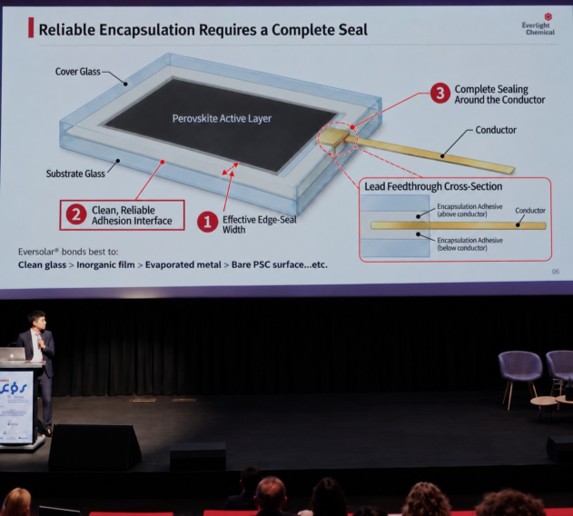
At ISOS-17 in Paris-Saclay, Everlight Chemical participated as a sponsor, exhibitor, and speaker. In our presentation, Eversolar® Encapsulation: From Research to Scalable Processing, we highlighted five practical issues that should be considered when moving from laboratory research to scalable encapsulation processes.
1. Why WVTR Alone Cannot Predict Device Lifetime
WVTR describes the rate at which moisture permeates through the bulk of a material. In an encapsulated photovoltaic device, however, moisture can reach the active area through more than one pathway. Two mechanisms are particularly important.
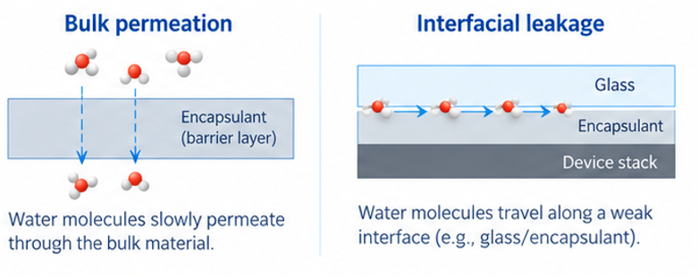
- Bulk Permeation: Moisture gradually permeates through the bulk of the encapsulant.
- Interfacial Leakage: Moisture travels along a weak interface between the encapsulant and the glass, electrode, or another device layer.
Therefore, even an encapsulant with a very low WVTR may not protect the device if interfacial adhesion is inadequate or delamination creates a faster pathway for moisture ingress.
Design principle Low WVTR cannot compensate for weak interfacial adhesion.
2. What Parameters Should Be Evaluated When Selecting a Perovskite Encapsulant
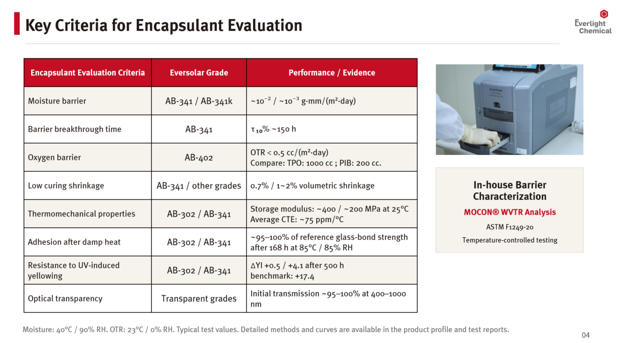
The ISOS-17 Encapsulation Round Table further emphasized that encapsulants should be evaluated as part of a complete system, rather than by a single performance value.
| Evaluation criterion | Why it matters |
|---|---|
| WVTR / OTR | Measures bulk permeation of moisture and oxygen through the material |
| Adhesion | Reduces the risk of interfacial leakage and delamination |
| Mechanical properties | Affect stress transfer during thermal cycling |
| Modulus at different temperatures | Describes material behavior across relevant operating temperatures |
| Optical transmittance | Affects the amount of usable light reaching the device |
| UV stability | Affects long-term optical and material reliability |
| Chemical compatibility | Reduces the risk of reactions with sensitive device layers |
| Seal geometry | Determines the effective diffusion distance before moisture reaches the active area |
| Curing and processing temperature | Determines process compatibility with thermally sensitive devices |
The Round Table also noted that research papers and technical data would be more useful for cross-team comparisons if they reported material thickness, WVTR and OTR test conditions, optical properties, glass transition temperature, and mechanical properties after curing. Two materials with similar WVTR values may still deliver different reliability after integration into a device.
3. Different Encapsulants Address Different Engineering Challenges
For perovskite and OPV devices, there is no single encapsulant that is optimal for every device architecture. The material families discussed at ISOS-17 involve different trade-offs in processing and reliability.
- Polyolefin Elastomer (POE): Has demonstrated good stability in photovoltaic modules, although conventional crosslinking may require temperatures of approximately 150°C.
- Thermoplastic Polyolefin (TPO): Can provide lower-temperature processing options, but transparency, UV transmission, and chemical composition may vary significantly among formulations.
- Thermoplastic Polyurethane (TPU): Offers greater flexibility and can absorb part of the mechanical stress, but yellowing, additives, and barrier performance still require evaluation.
- Silicones: Offer good flexibility, but generally provide relatively weak gas-barrier performance.
- Polyisobutylene (PIB): Is a mature and widely used edge-seal material, although formulation-specific compatibility should be evaluated before direct contact with sensitive perovskite materials.
- UV-Curable Liquid Encapsulants: Can provide an alternative low-temperature processing route for thermally sensitive perovskite structures.
Material selection Encapsulant selection should begin with the device architecture, reliability requirements, and intended manufacturing route.
4. Why Edge-Seal Width Matters
Material permeability is only one part of encapsulation barrier performance. After entering from the device edge, moisture must travel a certain distance before reaching the active area. With the same encapsulant, increasing the effective edge-seal width lengthens this diffusion path.
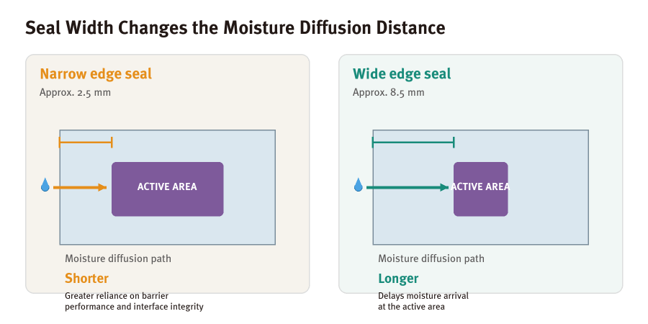
In the Eversolar® presentation at ISOS-17, we illustrated this effect using edge-seal widths of approximately 2.5 mm and 8.5 mm. A wider sealed region creates a longer moisture diffusion path.
Design principle WVTR and effective edge-seal width should be evaluated together.
Increasing the edge-seal width also reduces the usable active area. In space-constrained systems such as IoT devices, wearables, or space applications, the encapsulation border may need to remain very narrow. When the geometry cannot provide sufficient diffusion distance, the moisture-barrier performance of the material and stable interfacial adhesion become even more important.
5. Encapsulation Design Must Extend from the Laboratory to Manufacturing
An encapsulation method that works in the laboratory cannot always be transferred directly to a production line. As next-generation photovoltaic technologies move toward larger areas and commercial manufacturing, encapsulation must be integrated with coating, lamination, dispensing, curing, and module-handling equipment.
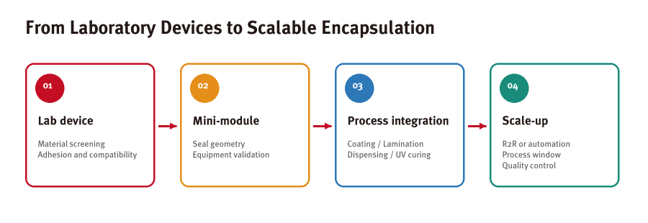
At ISOS-17, Everlight Chemical outlined potential scale-up routes for UV/VIS-curable encapsulants, including roll-to-roll processing and automated dispensing.
Roll-to-Roll Processing
Unwinding → Coating → Lamination → UV/VIS Curing → Rewinding or Cutting
Automated Dispensing
Automated dispensing equipment applies encapsulant or edge-sealing material precisely to designated areas of the module.
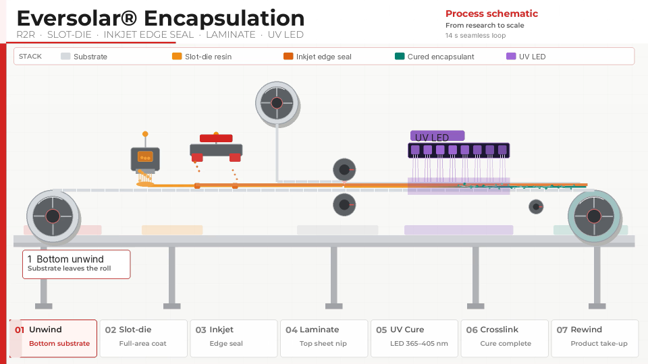
Scale-up principle Encapsulants and manufacturing processes should be designed together.
A material optimized only for manual laboratory application may encounter throughput, coating-uniformity, and equipment-integration challenges during scale-up. Considering process integration early can help narrow the gap between stable laboratory devices and manufacturable products.
From Research Collaboration to Device-Level Validation
Everlight Chemical’s work on photovoltaic encapsulation materials is expanding from material development to research collaboration and device-level validation.
During ISOS-17, we continued discussions with MOED – Henk Bolink’s group on PCB-based encapsulation, outdoor stability testing, and interlaboratory comparisons of different encapsulation protocols.
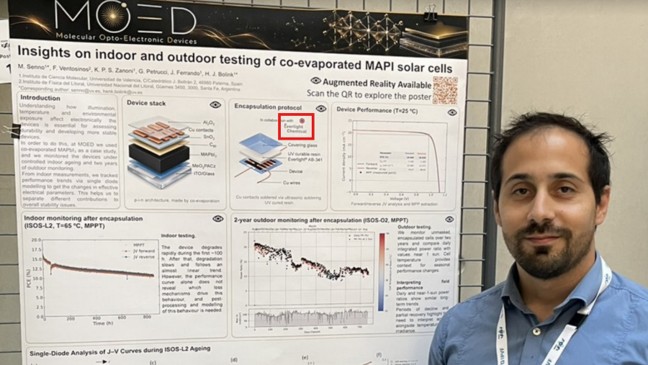
Material properties provide only part of the answer. Reliability must ultimately be validated in the complete device architecture.
Device-Level Examples from Published Research
In an EES Solar study, devices using an Eversolar® encapsulation system retained approximately 90% of their efficiency after 1,000 hours at 75°C under 1-sun illumination with maximum power point (MPP) tracking. EES Solar (2025), DOI: 10.1039/D5EL00145E.
In another study published in Nature Communications in 2024, perovskite solar cells using an encapsulation system that included Eversolar® AB-341 achieved T₁₀₀ > 1,930 hours under ISOS-D3 conditions at 85°C / 85% RH. Nature Communications (2024), DOI: 10.1038/s41467-024-54113-4.
Claim note These results reflect the performance of complete device and encapsulation architectures, not a lifetime specification for the encapsulant alone.
Toward More Complete Encapsulation Best Practices
Another important outcome of the ISOS-17 Encapsulation Round Table was the proposal to develop a living encapsulation guidance and best-practice document, together with a dedicated information-sharing group. Topics under discussion included:
- Encapsulant and supplier information
- Sample-access procedures
- Recommended processing methods
- Material compatibility
- Reliability results
- Material characterization and data disclosure
Without information on material thickness, curing conditions, seal geometry, and mechanical properties, stability results from different laboratories are difficult to compare meaningfully. As perovskite and OPV technologies move toward larger-area devices and commercialization, closer collaboration will be required among device researchers, material suppliers, equipment providers, and module manufacturers.
Frequently Asked Questions
Is Low WVTR Sufficient for Perovskite Solar Cell Encapsulation?
Not necessarily. A low WVTR reduces moisture permeation through the bulk material, but moisture may still enter along encapsulation interfaces or device edges. Adhesion, seal geometry, mechanical stability, and process quality must therefore be evaluated together.
Why Is Low-Temperature Encapsulation Important for Perovskite Solar Cells?
Some conventional photovoltaic encapsulation processes require relatively high lamination or crosslinking temperatures. For thermally sensitive perovskite devices, low-temperature curing can provide an alternative processing route.
How Does Edge-Seal Width Affect Reliability?
A larger effective edge-seal width increases the distance moisture must travel before reaching the active area. Barrier performance and seal width should therefore be evaluated together.
What Data Should Be Reviewed When Selecting a Perovskite Encapsulant?
In addition to WVTR and OTR, the evaluation should include adhesion, mechanical properties and modulus at relevant temperatures, optical transmittance, UV stability, chemical compatibility, curing conditions, and seal geometry.
Can UV-Curable Encapsulants Be Used in Scalable Manufacturing?
Depending on the device and production-line design, UV/VIS-curable materials can be integrated with automated dispensing, coating, lamination, and roll-to-roll processing.
From Stability Research to Scalable Reliability
ISOS-17 reinforced an important principle for next-generation photovoltaic encapsulation.
Long-term reliability cannot be achieved through an impressive barrier value alone.
Effective encapsulation requires an integrated understanding of moisture transport, interfaces, mechanical properties, material compatibility, seal geometry, and manufacturing processes. As perovskite and organic photovoltaics move toward larger areas and industrial applications, integrating these factors will be critical to translating laboratory stability into reliability under real operating conditions.
Everlight Chemical will continue to collaborate with universities, research institutes, and industry partners to explore more reliable photovoltaic encapsulation solutions, from laboratory devices and mini-modules to scalable processing.
Discuss Your Encapsulation Requirements with the Eversolar® Team
Whether your priority is high moisture-barrier performance, narrow edge seals, low-temperature curing, mini-modules, or manufacturing-process integration, we welcome further technical discussion and material evaluation.
Technical Sources
- Everlight Chemical, Eversolar® Encapsulation: From Research to Scalable Processing, ISOS-17 Sponsor Talk.
- ISOS-17 Encapsulation Round Table discussion notes and summit debrief supplied for this article.
- EES Solar (2025), DOI: 10.1039/D5EL00145E.
- Nature Communications (2024), DOI: 10.1038/s41467-024-54113-4.